The CAMi Artist Residency program is an affordable housing program with 18 homes on one block surrounding the Contemporary Art Museum of Indianapolis or CAMi. These are a combination of co-ownership between the artist and Big Car, long-term affordable rentals, and spaces for short-term stays for visiting artists — often in partnership with other organizations.
This program was originally called the Artist and Public Life Residency or APLR program. We renamed it with the CAMi campus in early 2026 when Tube Factory also rebranded.
Learn about our current long-term artist residents here.
What are the goals for the program?
We’ve worked, every step of the way, with input from existing neighbors (whom we are dedicated to retain). And all aspects of the long-term residency match with goals of the quality of life plan for our neighborhood that focuses heavily on affordable housing, avoiding displacement, and bringing artists to the southside.
Our biggest goal with the long-term residency is to create a perpetual system to avoid future displacement of artist neighbors from affordable housing while they collaborate with other neighbors to boost the community’s culture, creativity, livability, safety, health, and economy. In the co-ownership and rental options, costs are adjusted for affordability and the residency is linked to work — often together with other artists in the program — in support of the neighborhood and broader community.
Why artists?
Artists are a vital voice at the table when addressing challenges with cross-sector approaches to boosting quality of life. And, as an arts organization that formed in 2004 to support our home neighborhood, Big Car has much experience working with artists to support overall quality of life. The long-term residency approach gives Indianapolis artists a platform for bringing fresh ideas, energy, and imagination into the mix. And Big Car staff supports resident artists getting involved as leaders to work as creative problem solvers and builders of a more socially cohesive community.
What does it mean to be a CAMi long-term artist resident?
The artists are asked to commit about 16 hours a month of time toward things like communicating with each other, connecting with neighbors, and doing public-facing projects or programs that support community. Artists may support efforts on the block where they live, but they are not asked to do work for Big Car and are not involved — except when paid for their time — in doing work for Big Car.
So there’s no link — and never has been — to rent or homeownership payment and the exchange hours that are focused on community art efforts. The exchange is a clearly stated commitment the artists make when applying to be part of the program. And their selection — with a committee of reviewers — is based on their previous community focused work and interest in this as part of their practices as artists.
You can read our full guidelines document that covers requirements for artists participating in the CAMi Long-Term Artist Residency program. These are all reviewed and signed with artists at the time of entering into a lease and are revisited, as needed, at lease renewals.
How does the program work?
Artists have been, so far, selected by panels that have included neighbors, other resident artists, Big Car staff, and artists who work in community from other cities.
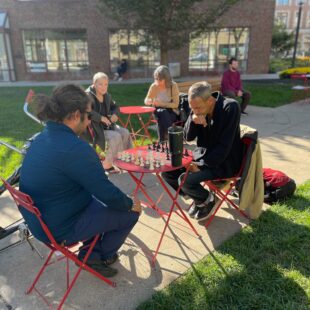
A key part of our CAMi campus work on a single block on the near southside of Indianapolis, the CAMi long-term residency program supports artists who team up with neighbors (and others across the city) to strengthen our block, the southside, and the broader community through arts-based approaches.
For this program, we consider artists to be creatives, makers, teachers, designers, and more. Fields include — and are not limited to — architecture, culinary art, curation, visual art, public art, furniture, fashion, craft, design, film and video, creative writing and journalism, performing arts, music, theater, placemaking, socially engaged art, etc. We also welcome leaders who work in nonprofit cultural or community organizations and educators who share their love of art, creativity, and community with their students.
In addition to the discount, being part of the CAMi long-term residency also comes with access to some shared resources as well as marketing and professional development support.
Note: All of our homes are full and we’re not currently accepting applications. We’re also developing our short-term artist residency program and will have more information on that forthcoming.
How did the program happen?
The CAMi Artist Residency program began taking shape in 2016 as a partnership between Big Car Collaborative and Riley Area Development, a nonprofit community development organization. Big Car co-founders Jim Walker, Shauta Marsh, additional Big Car board leaders and staff members, and consultants (including artist and planner Danicia Monet) researched and developed the program based on best practices around the country and world — in addition to our own innovative approaches.
The first artist moved into the program in 2018. Since then, all 18 homes have undergone completed renovations of up to $150,000. The houses are currently full with 25 artists and their family members.
Our long-term artist residency program is unlike anything else in our city and has gained much national and international attention. The program and the renovations of the homes are made possible through support of Glick Philanthropies, Lilly Endowment, the Herbert Simon Family Foundation, Allen Whitehill Clowes Charitable Foundation, the Indianapolis Neighborhood Housing Partnership (INHP), Efroymson Family Fund, Impact 100, and others.
Who owns the houses?
All of the homes are owned by our nonprofit, Big Car (which is officially named Big Car Media, Inc.) In three cases, homes are co-owned with artists who paid half of the market value of the house at the time of purchase. These three homes function as a community land trust that allows the artists to gain financial equity in their home should they decide to someday sell and move. At that point, the nonprofit will ensure that the homes are sold again to a qualifying artist. A central idea of this — and why we did it in the first place — is to preserve long-term affordability of housing for artists who support their community on the block anchored by our contemporary art museum, CAMi.
With the co-owned houses, our nonprofit is responsible for major repairs like roof, foundation, and sewer and water connections. These three houses are listed as 51 percent owned by Cruft Street Artists Residences, originally a nonprofit partnership with Riley Area Development, a community development nonprofit that has since disbanded. Now, the lone owner of Cruft Street Artist Residences is our organization, Big Car.
Other than artist co-owners, no other individual has ownership stake in these houses or any others in the CAMi Artist Residency program. And, in adherence to federal and state rules and laws for nonprofits, no individual can or will personally benefit from rental income or increased property value of the houses. People are able to verify ownership of properties in Indianapolis via MapIndy. A place to start with our block is at our organization’s address: 1125 Cruft St.
So the people who benefit from the program are the artists who have more affordable rent (30 to 50 percent off of market rate) or home co-ownership and members of the community who are reached by these artists selected for their commitment to public-facing art practices.
More detailed history
In partnership with Riley Area Development and supported, initially, by INHP, the program — originally called the Artist and Public Life Residency program or APLR — includes houses that were previously vacant, some for a very long time.
These efforts have happened in close partnership with current residents as a way to work together to further strengthen the neighborhood and keep affordable housing for artists in place. We partnered with our neighborhood associations and the South Indy Quality of Life Plan organization to match up with strategies for affordable housing in the area. And we all team up on efforts to avoid the displacement of existing residents. The main strategy is communication about what is happening and encouraging people to stay.
Throughout this process, we’ve researched other initiatives around the country as well as teamed up with expert volunteer teams — like Ursula David of Indy Mod homes and Axis Architecture — to develop this program and renovate five formerly boarded-up houses in our first round of work.
Indy Mod and Axis adopted our first house to transform into what become a lovely home for an artist across from Tube Factory. Our first artist moved into their home in 2019. With more than 300 applicants via multiple rounds so far, the long-term residency homes have been fully occupied the entire time since.
These homes are serving as a catalyst for positive activity on a short block that dead ends into an interstate highway that has caused challenges for the neighborhood now boosted by the nearby IndyGo Red Line bus rapid transit, with a stop at the end of the block.
We focus on artists in the program because Big Car Collaborative is an arts organization working in partnership with a nonprofit community development corporation to support the neighborhood where we are based and, with multiple staff members, where we live.
This project is linked to larger efforts on the block funded by a $3 million grant by Lilly Endowment announced in December of 2018. Learn more about that here.
Read local and international media coverage of our residency project here.
Additional keys to this project and the future of our Cruft Street micro community:
• We live in the neighborhood, communicate and work with neighbors as neighbors — and welcome everyone.
• Our programming is about social cohesiveness first — with art as an avenue to bringing people together.
• Artists help create physical improvements that are part of improved social infrastructure.
• We support public transit (the nearby Red Line bus rapid transit), walkability, and bike access.
• We bought most of these previously vacant properties early before market forces began to influence price. And that’s very much how this was possible.
• We are not displacing anyone with this project and are, instead, moving people with low incomes into long-term affordable housing.
• We team up with partners (some covering our gaps in our expertise).
• We aren’t concerned about profit for reinvestment in the next project.
• We’re creating an open/porous cooperative co-housing community vs. a closed one that is for members/owners only.
• We value active public and third spaces and help create them when needed and when invited.
• Artists welcome the idea of supporting the community as part of the reciprocal exchange for affordable housing and studio affordability — and have responded positively to this aspect.
• We gather numbers, stories and input, revising and adjusting the program along the way.