

- This event has passed.
Blue Blood: Félix Labisse’s Goddesses, Demons, and the Space Between
February 6 @ 6:00 pm - March 15 @ 3:00 pm
Free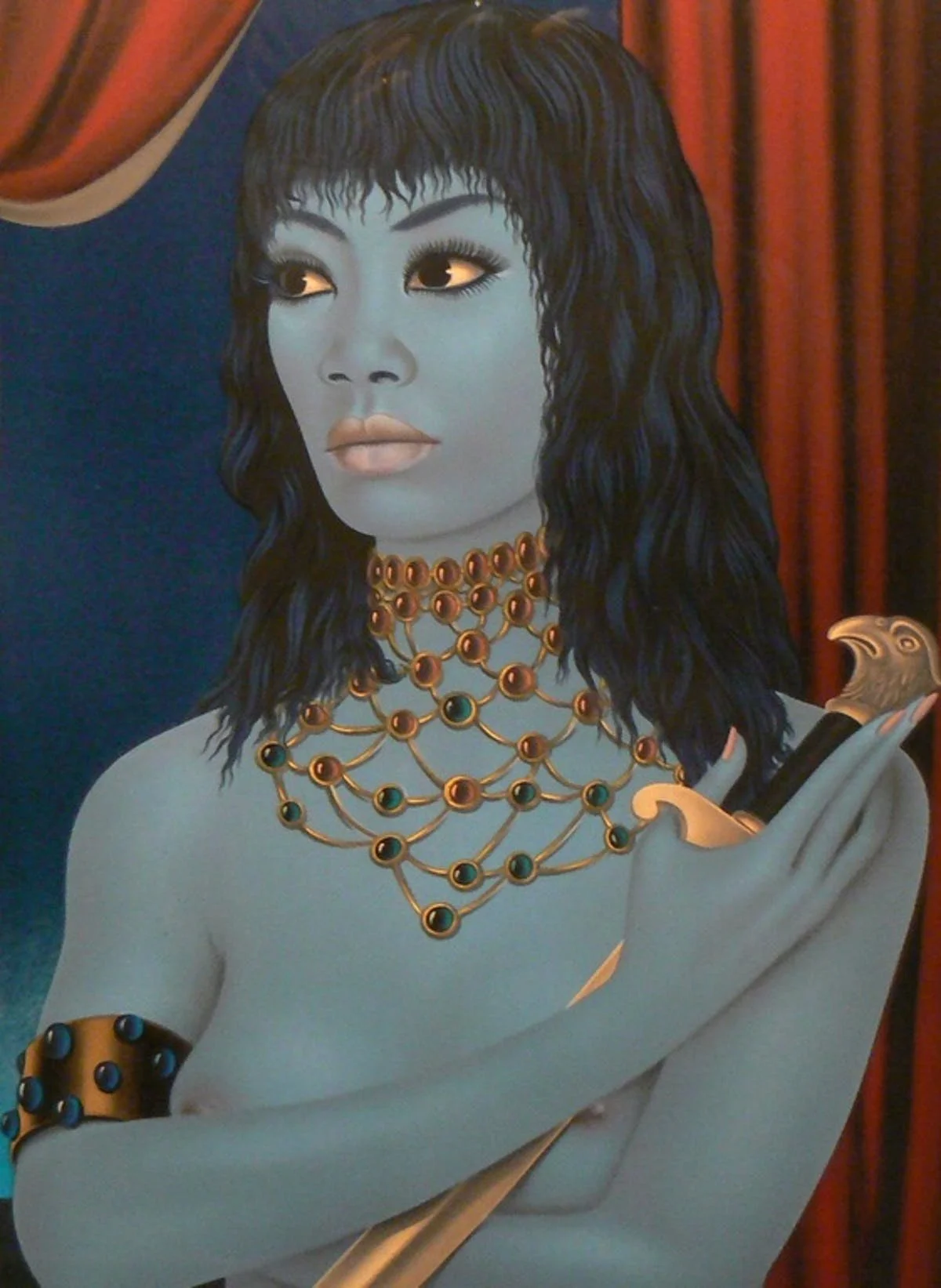
Friday, Feb. 6 – Sunday, March 15 | Tube Main Gallery
French Surrealist Félix Labisse created something strange starting in the 1960s: a universe where women pilot impossible machines through realms that don’t follow normal physics. His iconic blue women — the “Selenides” — are warrior goddesses. And they’re navigating more than space. They move through desire, mythology, and what might be parallel dimensions of time.
On the south wall of the gallery are three pieces from Labisse’s Selenide series: La Femme avec un couteau (The Woman with a Knife), La Reine de Saba (The Queen of Sheba), and Judith, referencing the stories and myths behind each warrior.
On the east and west walls are 16 prints from his Histoire naturelle series (1944)—hybrid creatures blending human, animal, and vegetable forms, each with Labisse’s own descriptive poems. These fantastical beings prefigure his later libidoscaphes (1962), desire-vessels that merge spacecraft with sexual organs and mythological beasts, navigating inner realms of “inadmissible desires masked by propriety.”
Part Jules Verne, part surrealist fever dream, part absurdist comedy, Labisse uses consciousness itself as a vehicle for traveling through forbidden dimensions where eroticism could actually warp reality. The nudity of Labisse’s female subjects is an armor. These women are preparing — for ceremonies, for magic, for battle. Their landscapes exist nowhere and everywhere at once: moon, ocean, future city, ancient temple. Set in mythic space, the women are real–piloting libidoscapes, navigating time, and fighting wars. Labisse enables us to see them through our own myths and knowledge of history. And imagine that perhaps because we see them, they are real. Imagine they are waiting, blue-skinned and patient, for the rest of us to catch up.
Labisse connected to science fiction, painting and drawing what he imagined. But in his work can be found an idea more radical—that artists might actually access non-linear temporal streams, tapping into futures and parallel timelines.
About the Artist
Félix Labisse (1905-1982) was a painter, illustrator, and theater designer who transformed mythology into what he called a “personal demonology.” Born in Northern France, he spent his early years in Douai and later Ostend, Belgium, where he met his mentor James Ensor while studying at the École de Pêche.
His childhood shaped everything: the Gayant carnival with its giant mannequins, living through WWI occupation from ages 9-13, and obsessively reading 19th-century science fiction. By 1933 he’d moved to Paris, where he quickly made a name designing theater sets (for Jean-Louis Barrault and later Jean-Paul Sartre) while painting and befriending other Surrealists—Robert Desnos, Max Ernst, René Magritte, Paul Delvaux. But Labisse never quite fit André Breton’s official Surrealist movement. He was doing his own thing: Flemish Expressionism meets occult symbolism meets erotic mythology. He was elected to the Académie des Beaux-Arts in 1966 and kept working until he died in 1982.
—-Curator Shauta Marsh
Research assistance: Louise Martin
Part one of a four part exhibition series on the artist.